
The 6 Ws of Field Service Are Only the Beginning
-

-
-

14 Jan, 2026
-

12 min read
-

Most field service businesses reach a point where things stop feeling simple.
Jobs are still getting done. Customers are still being served. Revenue might even be growing. But behind the scenes, pressure starts to build. Schedules become harder to manage. Engineers feel stretched. Admin increases. Small problems take longer to spot and even longer to fix.
This is often when frameworks enter the conversation.
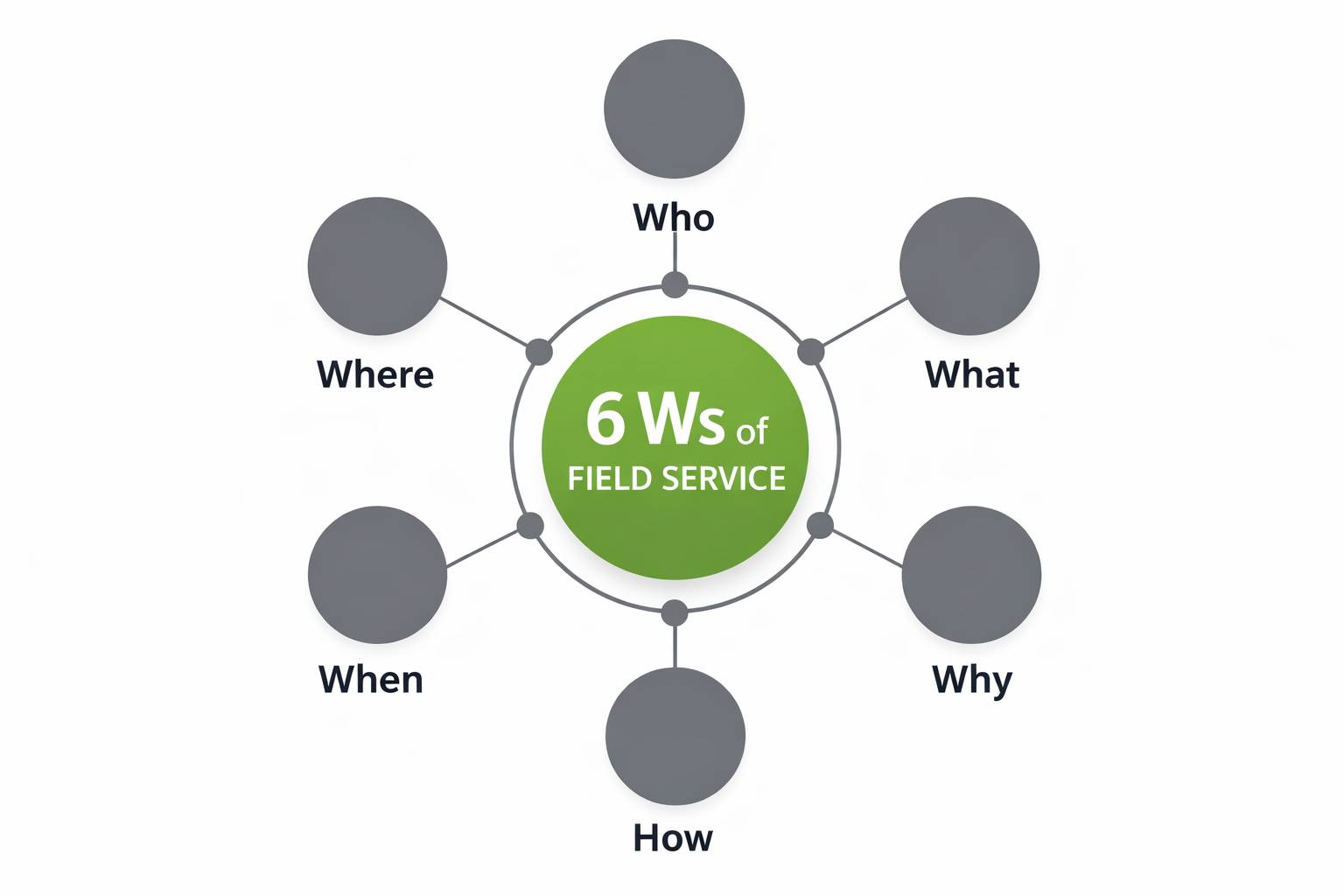
One of the most widely referenced is the 6 Ws of field service, a model popularised by Salesforce to help teams structure how work is planned and delivered. At a high level, the idea is straightforward. Every job needs six questions answered clearly:
-
Who is doing the work
-
What needs to be done
-
When it needs to happen
-
Where it will take place
-
Why the work is required
-
How it will be carried out
As a way of thinking about data and coordination, the 6 Ws are genuinely useful. They ensure nothing obvious is missing. They give dispatchers and technicians the information they need to act. But for many growing field service businesses, answering those six questions does not automatically lead to better outcomes.
Jobs still overrun. Schedules still break down. Profitability still feels harder to control. Teams still feel busy without feeling productive.
That gap is where most operational frustration lives.
Why the 6 Ws matter, but do not solve everything
The strength of the 6 Ws is that they force clarity. They make sure the basics are covered before work begins. In complex environments, especially at scale, that foundation matters.
Salesforce uses the framework primarily to ensure its field service platform can support every possible scenario. Every W has a corresponding data point. Every decision can be traced back to a record. From a system design perspective, that makes sense.
The challenge is that most field service businesses are not struggling because they lack information.
They struggle because growth changes how decisions are made.
When job volumes increase and teams expand, the problem is rarely that nobody knows who is assigned to a job or where it is located. The problem is that small assumptions no longer hold. Travel time increases without being noticed. Job scopes drift. Engineers spend more time coordinating than fixing. Admin processes fail to keep pace with operations.
The 6 Ws describe what a job is. They do not explain whether the business is set up to deliver that job efficiently, consistently, and profitably as it grows. That distinction matters.

Visibility comes before optimisation
One of the most consistent patterns in growing field service businesses is jumping too quickly to optimisation.
Advanced scheduling. Automation. Performance targets. New tools. All of these promise relief. But without a clear picture of what is actually happening day to day, optimisation tends to amplify existing problems rather than fix them.
This is why visibility is such a recurring theme in well run service operations.
Before you can improve scheduling, you need to understand where time is being lost. Before you can improve profitability, you need to know which jobs quietly cost more than they should. Before you can improve customer experience, you need to see where delays and rework are creeping in.
This is also where metrics play a crucial role.
In a previous article, we explored 10 metrics every growing field service business should track, not as a reporting exercise, but as a way to spot pressure early. Metrics like first time fix rate, technician utilisation, travel time per job, and jobs completed versus jobs invoiced reveal far more about operational health than any framework alone.
The 6 Ws tell you what needs to happen for a job to exist. Metrics tell you whether your business is coping with the way those jobs are actually being delivered.

Where growing businesses start to struggle
In smaller teams, gaps are obvious. Everyone feels them. When something goes wrong, it is visible immediately. As businesses grow, those gaps spread out.
A missed part here. An overrun there. A delayed invoice somewhere else. None of these issues feel serious on their own. Over time, they add up to a business that feels permanently stretched.
This is where many leaders feel frustrated. On paper, everything looks covered. The six questions are answered. Jobs are booked. Engineers are assigned. Customers are informed.
Yet outcomes keep slipping.
That is usually a sign that the problem is no longer about information. It is about consistency, decision making, and feedback loops.
[xyz-ihs snippet="Download-Brochure"]
Having answers is not the same as making good decisions
One of the quiet assumptions behind the 6 Ws is that once the right information exists, good decisions naturally follow.
In reality, that is rarely how field service works at scale.
A dispatcher can know who is assigned, what the job is, when it is scheduled, and where it needs to happen, and still struggle to make the right call under pressure. A technician can have all the details they need and still lose time due to poor sequencing, unrealistic expectations, or missing context.
The issue is not data completeness. It is decision quality.
As job volumes increase, the number of trade-offs increases with them. Do you prioritise proximity or skill match. Do you squeeze in one more job or protect schedule integrity. Do you send the nearest engineer or the one most likely to fix it first time.
These are not data problems. They are operational judgement problems.
The 6 Ws help make decisions possible. They do not make them easy.

Growth exposes weak assumptions, not weak teams
When businesses grow, it is tempting to frame new problems as people problems.
Engineers are less productive. Admin feels slower. Customers seem less patient. But in most cases, the people have not changed. The assumptions have.
Assumptions that worked at a smaller scale start to break down. Travel time that used to be negligible becomes a major factor. Job durations that used to be predictable start to vary. Informal knowledge that once lived in someone’s head becomes a bottleneck.
The 6 Ws do not capture these shifts. They describe each job in isolation. Growth problems emerge in the patterns between jobs.
This is why many businesses feel blindsided. Nothing looks obviously broken. Yet everything feels harder.
That tension is often the first sign that the business has outgrown its original operating model.
Why visibility beats optimisation in growing teams
When pressure builds, the instinct is often to optimise.
Tighter schedules. More automation. More rules. More targets.
Without visibility, optimisation becomes guesswork.
This is where metrics come back into the picture, not as performance management tools, but as early warning signals. Metrics show whether the assumptions behind the 6 Ws still hold true.
For example, you may know when a job is scheduled, but metrics reveal whether jobs are consistently overrunning. You may know who is assigned, but utilisation and billable time reveal whether capacity is being used effectively. You may know where work is happening, but travel time per job shows whether service areas still make sense.
This is why metrics like first-time fix rate, repeat visits, schedule adherence, and cost to serve matter so much during growth. They expose friction that frameworks alone cannot.
The goal is not to track everything. It is to see where reality is drifting away from the plan.

From individual jobs to operational patterns
The biggest limitation of the 6 Ws is that they focus attention on individual jobs.
That is useful at the point of execution. It is less useful when trying to run a business.
Operational control comes from spotting patterns over time. Where jobs consistently overrun. Which types of work generate the most rework. Which customers create the most pressure. Where admin delays slow down invoicing. Which days or areas experience the most schedule disruption.
None of that is visible when you only look at jobs one by one.
This is where growing businesses often feel stuck. They have plenty of information, but little insight. They can answer questions, but struggle to explain why the same problems keep repeating.
That gap is not a technology issue. It is an operating model issue.
The missing layer between data and delivery
If the 6 Ws describe the structure of work, something else needs to sit on top of them.
That layer is about consistency, feedback, and learning.
It answers questions like:
-
Are jobs being scoped in a consistent way
-
Are scheduling assumptions still realistic
-
Are engineers spending time where it creates value
-
Are operational issues being noticed early or only when customers complain
This is where metrics, process discipline, and clear accountability come together.
Not to control people, but to reduce friction.
Not to optimise every minute, but to protect quality and capacity as the business grows.

How mature field service businesses move beyond frameworks
As field service businesses mature, something subtle but important changes in how they think about operations.
They stop asking whether information exists and start asking whether it is useful.
At this stage, the 6 Ws are no longer a checklist. They are assumed. Every job has an owner. Every visit has a purpose. The basics are in place. What matters now is whether the business can learn from what is happening and adjust before problems become visible to customers.
This is where many growing teams stall.
They have enough structure to operate, but not enough feedback to improve. Work keeps flowing, but patterns go unnoticed. Decisions are made reactively, based on yesterday’s pressure rather than long-term insight.
Mature operations close that gap by connecting job data to operational signals.
Simplicity becomes more important as scale increases
One of the counterintuitive lessons of growth is that complexity does not require more complexity in response. It requires clarity.
As businesses add engineers, customers, and job types, there is a temptation to layer on more rules, more workflows, and more exceptions. Over time, that creates a system that is technically complete but operationally fragile.
High-performing service teams tend to move in the opposite direction.
They simplify wherever possible. They standardise how work is scoped. They reduce variation in how jobs are scheduled. They create clearer expectations around what good looks like.
The goal is not rigidity. It is predictability.
When work is predictable, decisions become easier. When decisions are easier, teams feel less pressure. When pressure drops, quality improves.
The 6 Ws still matter in this environment. They just sit quietly in the background, supporting a simpler way of working rather than driving it.
Connecting the 6 Ws to real operational signals
This is where frameworks and metrics meet.
Each of the six questions describes an aspect of work. Metrics reveal whether those aspects are functioning as intended.
For example:
-
You know who is assigned to jobs, but utilisation and billable time show whether capacity is being used effectively
-
You know what work is being done, but repeat visits and rework reveal whether jobs are being scoped and completed properly
-
You know when jobs are scheduled, but schedule adherence shows whether plans are realistic
-
You know where work happens, but travel time per job highlights whether service areas still make sense
-
You know why work exists, but customer retention shows whether outcomes meet expectations
-
You know how jobs are delivered, but cost to serve reveals whether the model is sustainable
This is why metrics are not an alternative to the 6 Ws. They are what give those questions meaning over time.
Without them, the business can answer questions but cannot improve answers.
Why pressure shows up before failure
Another important lesson from growing field service businesses is that failure rarely arrives suddenly.
Days start to overrun more often. Engineers feel rushed. Customers chase updates. Admin tasks slip. None of this looks dramatic in isolation. Together, it creates a constant sense of urgency.
This is where leaders often feel frustrated. They know the business is busy. They know the systems are in place. Yet things feel harder than they should.
That feeling is usually the first signal that the operating model needs attention.
Frameworks like the 6 Ws help describe work. Metrics help reveal strain. Neither solves the problem on its own.
The real progress comes from recognising when growth has changed the shape of the business and adjusting how decisions are made accordingly.

The 6 Ws are a foundation, not a solution
The most useful way to think about the 6 Ws is as a baseline.
They describe the minimum information needed for a job to exist and be delivered. Without them, field service becomes chaotic very quickly. With them, work can at least move forward in an organised way.
But growth changes the question.
Once a business reaches a certain size, the challenge is no longer whether jobs can be planned. It is whether the business can keep learning from how those jobs actually play out.
That is where many teams feel stuck. They have structure, but not control. They have information, but not insight. They know what is happening today, but struggle to explain why the same issues keep appearing month after month.
Frameworks like the 6 Ws help bring order. They do not automatically create improvement.
Regaining control during growth
The businesses that navigate growth most successfully tend to focus on visibility rather than optimisation.
They do not try to perfect everything at once. Instead, they look for signals that pressure is building and respond early.
This is where operational metrics become powerful. Not as targets to chase, but as feedback loops. They help leaders see where assumptions are no longer holding and where the operating model needs to evolve.
A declining first-time fix rate often points to issues long before customers complain. Increasing travel time signals that service areas or scheduling rules need attention. A widening gap between jobs completed and jobs invoiced highlights process strain before cash flow becomes a problem.
These numbers matter because they sit above individual jobs. They show how the system behaves under load.
When combined with the structure provided by the 6 Ws, they give leaders a clearer picture of how the business is really functioning.

From reactive to repeatable operations
The goal for a growing field service business is not to eliminate complexity. Some complexity is unavoidable.
The goal is to make performance repeatable.
Repeatable operations rely on a few core principles:
-
Clear and consistent job scoping
-
Realistic scheduling assumptions
-
Visibility into where time and effort are actually going
-
Early signals when pressure starts to build
When those elements are in place, teams spend less time firefighting and more time delivering quality work. Decisions feel calmer. Growth feels intentional rather than exhausting.
The 6 Ws still matter in this environment. They simply stop being the focus.
Instead of asking whether every job has the right answers, leaders start asking whether the business is learning from those answers and adapting as it grows.
Bringing it all together
Frameworks are useful. Metrics are useful. Neither is enough on its own.
The 6 Ws help describe the structure of work. Operational metrics reveal how that work behaves at scale. Together, they give field service leaders the visibility they need to grow without losing control.
If you are early in this journey, start with the basics. Make sure jobs are clearly defined. Make sure teams have the information they need. Then choose a small set of metrics that reflect your biggest pressures today and track them consistently.
Over time, the focus shifts. Less on answering questions. More on understanding patterns. Less on reacting to problems. More on preventing them.
That is when growth starts to feel sustainable.
And that is when frameworks like the 6 Ws become what they were always meant to be: a solid foundation, not the whole strategy.


