
Stop Saying You Offer Great Service (Everyone Does)
-

-
-

04 Feb, 2026
-

11 min read
-

Here's a question I ask field service business owners all the time: What makes you different?
The answer is almost always some version of the same thing. We provide great service. Our engineers are reliable. We've been doing this for years. Our people are friendly and do the job right.
Look, none of that is wrong. But here's what I need you to understand: none of it is a differentiator either.
Think about it. In your market right now, how many of your competitors could make those exact same claims? Probably all of them, right? And that's the problem. When everyone sounds the same, buyers can't figure out who to choose. So what do they do? They compare prices, they delay the decision, or they just stick with whoever they're already using.
So let's talk about why "great service" actually works against you, and what you should be doing instead.
You're All Saying the Same Thing (And Buyers Know It)
Go look at five field service websites in your industry right now. I'll wait.
What did you see? Let me guess: Reliable. Responsive. Professional. Customer-focused. Trusted by local businesses. Years of experience.
Sound familiar? That's because every single one of your competitors is saying the exact same thing.
Now, I get it. From inside your business, these statements feel important. They represent real effort, real pride in your work. But here's what you need to understand: from the buyer's perspective, they're just noise.
Why? Because buyers expect all of that as a bare minimum. Nobody wakes up thinking, "You know what I'm looking for? A field service company with unreliable engineers who don't care about quality." That's not a thing.
When every provider clears that basic bar, those qualities stop mattering in the decision. And here's where it gets worse: when buyers can't see any real differences between you and everyone else, they default to the easiest comparison they can make. Price. Or they pick whoever they already know. Or they just don't make a decision at all.
You're not helping them choose you. You're making it harder.

Here's What You're Actually Doing Wrong
Most field service companies are confusing two completely different things: reassurance and value.
Let me explain what I mean.
Reassurance answers: "Is this a safe choice? Will I regret this?"
Value answers: "Why should I pick you instead of everyone else?"
When you say "great service" or "fully trained engineers" or "excellent support," that's reassurance. You're basically saying, "Don't worry, we're not going to screw this up." And look, that matters. But it doesn't give buyers a reason to choose you in the first place.
Here's the thing: reassurance only works after someone already has a reason to care. You need to give them that reason first. Then reassurance helps remove the final friction.
But what most service businesses do is flip this around. They lead with all the reassurance stuff and never get to the actual value. So buyers never reach the point where reassurance even matters. They're stuck at, "Okay, but why you?"
This is exactly why companies that obsess over service quality still struggle with price pressure and deals that take forever to close. They're answering the wrong question first.
What's Really Going Through Your Buyer's Head
When a buyer tells you that all the field service companies "look the same," they're not saying your services are identical. What they're actually saying is: "I can't figure out how to make this decision without potentially getting in trouble."
Because here's what's really happening. Your buyer isn't just comparing service features. They're thinking about stuff like:
- "How much chaos is this going to create in my day-to-day?"
- "Am I going to spend half my time managing these people?"
- "If this goes wrong, am I the one who's going to look stupid?"
- "Is this going to make my life easier or just give me more headaches?"
Most field service companies completely miss this. They show up with their list of services and say, "Look, we do all this stuff really well." Great. But you just made the buyer do all the work of figuring out whether that actually solves their problem.
And when buyers have to do that work themselves, you know what happens? They take the path of least resistance. They pick the cheapest option. Or they stick with whoever they're already using. Or they just punt the decision down the road and hope someone else deals with it.
April Dunford talks about this a lot in her work on positioning. She points out that when buyers can't confidently understand why one option is better for their specific situation, they default to "no decision." And in B2B, that happens 40-60% of the time. Think about that. Half your potential deals die not because customers chose a competitor, but because they couldn't figure out how to make any choice at all.
Good positioning fixes this by making the decision obvious for the right type of customer.
You Already Have Differentiation (You Just Haven't Noticed It)
Here's something I see all the time: field service owners who swear they have nothing that makes them different. "We're just like everyone else," they tell me. "We do the same work, same way."
But that's almost never true.
What's actually happening is they're looking at what they do instead of looking at who chooses them and why.
Try this. Look at your customer base right now. Which jobs closed easily? Which customers never complain and always renew? Which projects were actually profitable and smooth to deliver? I guarantee you'll see patterns. And those patterns are your differentiation. You just haven't put words to it yet.
Maybe you keep winning work where compliance documentation matters more than speed. Maybe facilities managers choose you because you reduce the coordination headaches they deal with. Maybe you're the go-to when there are multiple contractors involved and someone needs to make sure nothing falls through the cracks.
None of that shows up when you say "great service." But it's real. It's why certain customers pick you over everyone else.
This is what April Dunford means when she talks about positioning. Your positioning isn't something you invent. It's something you uncover by looking at the customers who already love you and figuring out what they have in common. If you're thinking, 'That's great, but we really don't have anything that makes us different,' watch this.
April walks through exactly how to uncover the differentiation that's already hiding in your business:
[embed]https://www.youtube.com/watch?v=Vw3bd40nUDc[/embed]
What Real Differentiation Actually Looks Like
Let me give you some examples of what I'm talking about. And notice: none of these require radical innovation or fancy technology. They're just operational choices that make certain customers say, "Yes, that's exactly what we need."
There's a maintenance provider I know that specializes in reducing unplanned downtime for companies with multiple sites. They're not the fastest at emergency response, and they're not the cheapest. But for multi-site operators who can't afford unexpected shutdowns, they're the obvious choice. They do way more upfront planning than their competitors, and their customers are happy to pay for it.
Or think about a contractor that's set up specifically for compliance-heavy industries. Healthcare, food processing, places where audit trails and documentation aren't optional. Most contractors treat that stuff as a pain. These guys built their whole operation around it. For their target customers, working with anyone else feels like pulling teeth.
Here's another one: a service business that refuses to do emergency work. Sounds crazy, right? But they only work with facilities managers who value predictability and clear scheduling. They plan everything out, they show up when they say they will, and their customers know exactly what to expect. For facilities teams running on tight budgets with limited staff, that predictability is worth more than having someone on call 24/7.
See what's happening here? Each of these companies is telling a specific type of buyer, "We built this for people like you." And once a buyer sees themselves in that message, service quality becomes something they expect, not the main reason they choose you.
Why Starting With "We're Great" Actually Makes You Look Worse
So if reassurance matters, why not just lead with it? Why not make sure everyone knows you're reliable and experienced right from the start?
Two reasons.
First, it makes you invisible. When your opening pitch is all about reliability and experience and friendly service, you've just put yourself in the exact same bucket as every other competent company out there. The buyer still has no idea why you're the right fit for their specific situation. You're just another option in a sea of options that all sound the same.
Second, and this is subtle, but important: over-emphasizing reassurance can actually create doubt. When you spend a lot of time talking about how easy you are to work with, or how much support you provide, or how well-trained your team is, you might accidentally make the buyer wonder, "Wait, is this normally hard? Do other companies struggle with this? Is there something I should be worried about?"
Look, reassurance absolutely has a place. But it needs to come after you've given someone a reason to care. The most effective field service businesses lead with a specific outcome they deliver for a specific type of customer. Then, once the buyer sees why this matters to them, reassurance helps seal the deal.
Think about it this way: you don't need to convince someone that you won't mess up until they're already interested in working with you.
So What Should You Actually Be Saying?
Your positioning needs to answer one straightforward question: Who is this for, and why should they care?
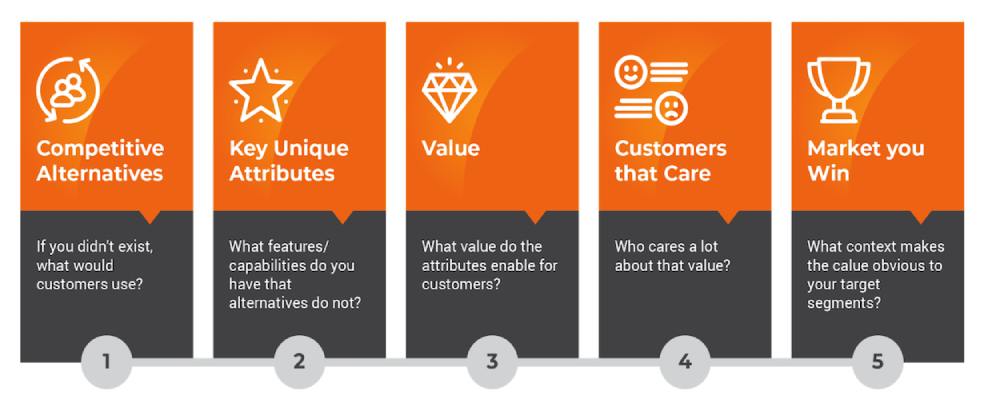
April Dunford has a framework for this that breaks it down perfectly:
First, what's the alternative? If you didn't exist, what would your customer do instead? Maybe they'd use a spreadsheet. Maybe they'd hire someone in-house. Maybe they'd just suffer through the problem. You need to know what you're competing against, because that's how customers measure "better."
Second, what can you do that the alternatives can't? And I'm not just talking about features here. Maybe you have a different delivery model. Maybe you have expertise in a specific area. Maybe your pricing structure works differently. These are your unique capabilities.
Third, what value does that create for certain customers? Because features only matter when they translate into something a customer actually cares about. Maybe you reduce downtime. Maybe you eliminate coordination headaches. Maybe you make compliance easier.
When you nail those three things, your message becomes way more specific. Instead of "we offer great service," you might say "we reduce unplanned disruption for multi-site operations." Instead of "we're experienced," you might say "we deliver predictable outcomes in environments where multiple contractors are involved."
See the difference? These statements give buyers something to latch onto. They can immediately assess whether this is relevant to them. And once they see that relevance, everything else you say lands differently.
This is what good positioning does. It makes your value obvious to the right people.
Keep It Simple (Seriously)
Here's the good news: your positioning doesn't need to sound fancy or complicated to work.
In fact, simple language usually works better. Your buyers want clarity, not clever wordsmithing. They want to quickly understand if you're relevant to them or not.
The goal isn't to explain everything you can do. The goal is to help the right customer immediately see why they should talk to you.
And yes, that means your positioning won't appeal to everyone. That's not a bug, it's a feature. When you narrow your message, you attract the work that fits and naturally filter out the work that doesn't. Over time, that makes everything easier. Sales conversations flow better. Projects run smoother. Margins get healthier.
You don't need to be for everyone. You need to be obviously right for someone.
A Quick Test You Can Run Right Now
Want to know if "great service" has become a crutch in your messaging? Here's a simple test.
Grab someone who doesn't work in your business. Show them your website or a recent proposal. Then ask them: "Based on what you just read, what type of customer is this clearly designed for, and what problem does it solve better than the alternatives?"
If they can't give you a clear answer, or if their answer could apply just as easily to your competitors, your positioning isn't doing much for you.
Here's another way to check: look at your best customers. And I don't mean your biggest customers. I mean the ones who are easiest to work with, most profitable, and most likely to renew or recommend you.
What do they have in common? Why did they choose you? There's almost always a pattern there. And that pattern is way more valuable than any "great service" claim you could make.
Those customers are telling you what your actual differentiation is. You just need to listen.
How This Fixes Your Price Problem
When buyers can't see meaningful differences between options, what do they fall back on? Price. It's the easiest thing to compare.
But clear positioning changes the conversation. Instead of "Who's cheaper?" the question becomes "Which option actually fits our situation?"
Look, this doesn't make price disappear as a factor. But it does reduce how much it matters. Buyers are willing to pay more when they can see why your service is specifically designed for their needs.
And here's what else happens over time: your sales process gets way more efficient. Fewer deals stall out. Fewer proposals turn into pure price comparisons. You start attracting the work you're actually set up to deliver well.
That's when things really start to click.
[xyz-ihs snippet="Download-Brochure"]
The Bottom Line
Field service companies don't stand out by claiming they care more, work harder, or deliver better service. Your credible competitors are already saying all of that.
You stand out by making it immediately clear to the right buyers why you're the right choice for them specifically.
That means less time on broad assurances and more focus on the specific outcomes you deliver for specific types of customers. When buyers can see themselves in your message, the decision gets easier. When the decision gets easier, everything else in your sales process improves.
So stop trying to be all things to all people. Figure out who you're actually best for, and make that crystal clear. That's how you break out of the "great service" trap and actually start differentiating yourself.


