
Marketing for Plumbers: How to Get More Customers Without Wasting Your Budget
-

-
-

13 May, 2026
-

13 min read
-
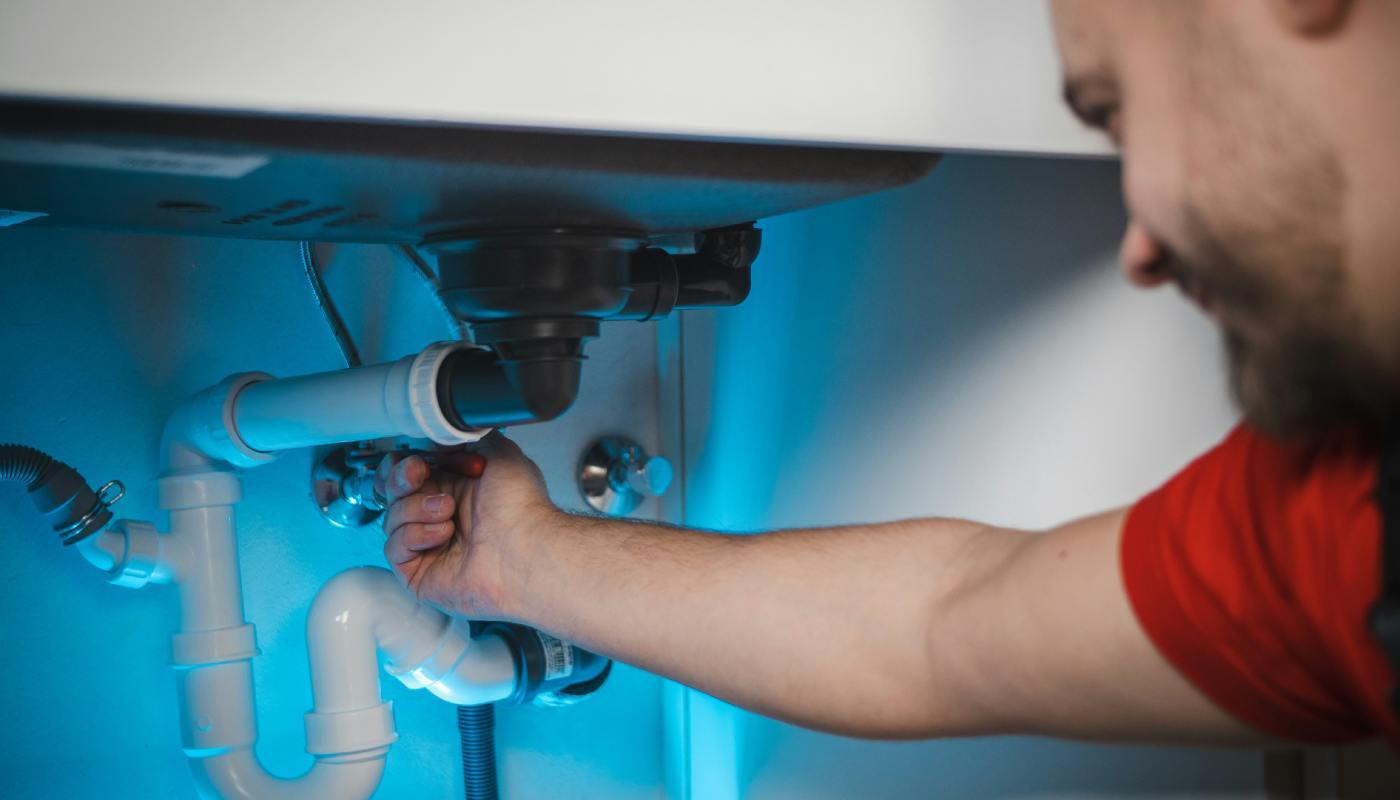
Here's something worth sitting with. Nobody wakes up in the morning wanting to call a plumber. If someone's picking up the phone to find you, something has already gone wrong: a burst pipe, a boiler that won't fire, a blocked drain that can't wait. Your customers aren't shopping for a relationship. They're in a moment of stress, they want the problem solved, and they're going to call whoever they can find and trust fastest.
That's the whole game. And most plumbers lose it not because their work is poor (it rarely is), but because they're invisible at the moment it matters, or they haven't done enough beforehand to be the name that comes to mind first.
Here we cover what actually works for marketing a plumbing business in the UK, why some tactics take hold and others drain your budget, and what to do first if you're starting with limited time or money.
Table of Contents:
- You’re in the marketing business as much as the plumbing business
- The biggest mistake most plumbers make
- Start with what you already have
- Getting found when people search
- Reviews: where most plumbers leave money on the table
- Social media: community, not advertising
- Building your name before people need you
- Networking: still the cheapest way to start
- The role of paid advertising
- Video: the channel most plumbers ignore
- Making it all work together
You're in the marketing business as much as the plumbing business
The mindset shift that makes everything else easier: your business doesn't run on plumbing skills alone. It runs on customers finding you, trusting you, and choosing you over the three other plumbers who just came up on Google. You might be technically excellent and still lose jobs to someone with a better van wrap, more recent reviews, and a faster callback.
Customers buy from people they know, like, and trust. In that order. Know comes first. They can't like or trust someone they've never heard of. So everything in your marketing, from your van to your website to how your phone gets answered, is working on that first problem: making sure people in your area know your name before they ever need you.
When you're out on a job and they stop and spot your van, that's marketing. When someone's neighbour says "who did your boiler?" The answer is your marketing. When you don't answer a call and it goes to voicemail, that's marketing too. Everything is marketing, and it either builds your reputation or quietly chips away at it.
The biggest mistake most plumbers make
A lot of plumbing businesses think they have a marketing problem. Often, they have a systems problem. They rely heavily on word of mouth, which is great when it comes in, but you can't predict it and you can't scale it. Word of mouth builds a business to a point, and then it plateaus.
The other common trap is putting all your eggs in SEO. SEO for plumbers is genuinely different from other trades. In any decent-sized market, there are dozens of plumbers all competing for the same small number of organic spots on Google. Those spots are also shrinking. Google Local Service Ads, the map pack, and directory listings now dominate most of the first screen before organic results even appear. If you've been paying an SEO company for a year and feel like you're going backwards, you're not imagining it.
That doesn't mean SEO is worthless. Relying on it as your only source of new customers is a fragile strategy. What you need is a proper marketing stack: a Google Business Profile that's genuinely maintained, some presence on paid search, a website that actually converts, a flow of fresh reviews, and activities that build your name in the community. Those things work together. Each one makes the others more effective.
Start with what you already have
Before spending money on ads, look at what's already in front of you.
Your existing customers. Every person you've ever done work for is a warm lead. They've already trusted you with access to their home and paid you for your time. A quick text to check in ("Hi, just following up to make sure everything's still good with the work we did last year") costs nothing and reminds them you exist. Some will have something else that needs doing. Some will refer you to a neighbour. According to a study by BrightLocal, 84% of people check Google reviews before choosing a contractor. If your past customers haven't left you one, ask. Not once, but as a consistent habit after every job.
The job you're already on. Your biggest marketing opportunity might not be online at all. When you complete a job in a street or estate, you're standing in a neighbourhood full of people who will eventually need a plumber. A few door hangers on the nearest houses (something simple like "We were just next door — here's 10% off your first job") takes five minutes and puts your name in front of people who already know someone who trusted you. That's social proof built into the geography. A tidy yard sign while you're working does the same thing.
Your van. A well-branded van is a moving billboard. Drive through enough streets enough times and people start to feel like they see you everywhere. A poorly done vinyl transfer on a dirty white van does the opposite: it tells people you don't take pride in your presentation. If a potential customer wouldn't feel comfortable with you parked outside their house, your van's branding needs work.
Getting found when people search
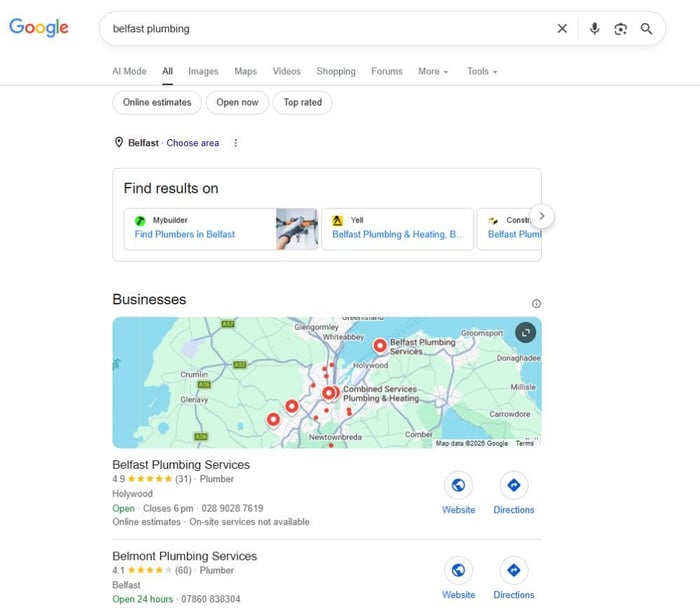
When someone's boiler stops working at 10pm and they open Google, the customer journey is quick: search, look at the top results, check a few reviews, call whoever looks most credible. You have seconds.
Google Business Profile is the single most valuable free tool available to you. It's what shows up in the map pack: the three businesses that appear on the map results for "plumber near me." Getting there takes consistent effort: keep your profile complete and accurate, upload photos regularly, respond to every review (including the negative ones), and post updates occasionally. Every time you post something, you tell Google's algorithm that you're an active business worth showing to local searchers.
Your response to a negative review matters more than you might think. When you respond calmly and professionally to a complaint (acknowledging the issue, explaining what happened, and offering to put it right) you're not talking to that unhappy customer. You're talking to everyone else who reads it. A composed, reasonable response to a critical review actually builds confidence. An argumentative one destroys it.
Google Local Service Ads are worth understanding for plumbers. Unlike standard pay-per-click ads, you pay per qualified lead rather than per click. Google vets businesses before listing them in LSAs, which gives the "Google Screened" badge genuine trust value in the eyes of customers. They appear above almost everything else on search results. If you're not using them, your competitors probably are.
Your website needs to do one thing well: make it easy for someone who lands on it to contact you, fast. Phone number visible at the top on mobile. Clear list of your services and the areas you cover. Recent photos of your work and your team. A handful of fresh reviews. That's the essentials. If your website hasn't been updated in three years, it's working against you. See the field service website checklist for a practical maintenance routine.
Reviews: where most plumbers leave money on the table
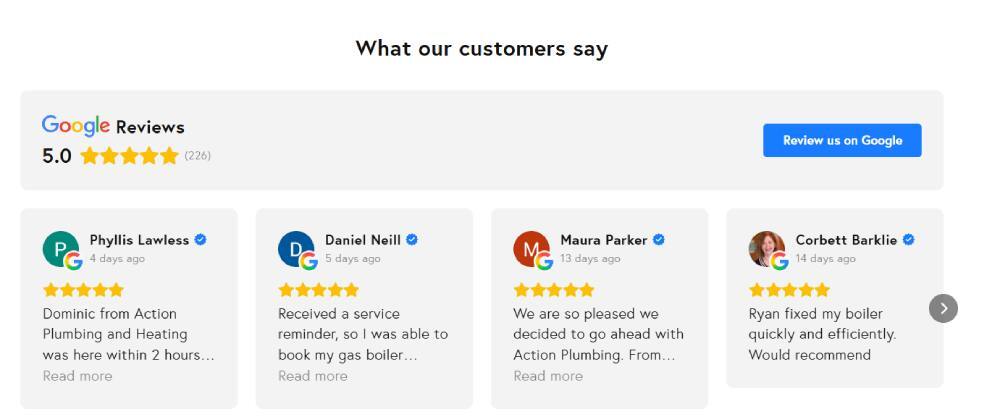
This comes up in every conversation about plumbing marketing because it's true. Reviews are the thing most plumbers consistently underlook, even though they cost nothing to collect and drive more decisions than almost any paid activity.
Studies show it takes around seven touchpoints before a potential customer remembers your brand. But when they do finally search, reviews are often the deciding factor between clicking on you or the plumber below you. A business with 4.9 stars and 200 reviews beats a business with 5 stars and 4 reviews every time, because volume signals that people have actually used you.
The ask is simple. Finish the job. Make sure the customer is happy. Then say: "Would you mind leaving us a quick Google review? It really helps us out." Send a follow-up text with the link. That's it. Make it a habit after every job, not an occasional thing when you remember.
Don't just collect reviews. Display them. Put them on your website. Share them on social media. When a potential customer looks you up anywhere, they should find consistent evidence that real people have used you and been happy.
Social media: community, not advertising
Most plumbing businesses either don't do social media at all, or they use it as a billboard for promotions nobody asked for. Neither approach works particularly well.
What does work: showing up as a genuine part of the local community. Post a before-and-after photo of a job well done. Introduce your team. Share something useful, like "three signs your boiler needs servicing before winter" gets shared far more than an ad for 10% off.
The best use of local Facebook groups isn't advertising. Join the neighbourhood groups in the areas you work. When someone asks for a plumber recommendation, you want to be there, ideally as yourself rather than your business page, to respond helpfully. People can tell the difference between someone who wants to help and someone who wants the sale.
Consistency matters here more than frequency. Posting twice a month for two years does more for your reputation than posting every day for three months and stopping. When your marketing disappears, you don't pick up from where you left off. You start over. Stopping and starting costs you more than most businesses realise.
Building your name before people need you
The businesses that grow steadily have a presence in their community that predates the marketing conversation. They show up on Google. But they're known.
Sponsoring a local youth sports team is the simplest version of this. Your name on a match day programme or on the back of a junior football kit sits in front of parents, grandparents, neighbours, and teachers. It's not measurable in the way Google Ads is. That's not the point. The point is mindshare: the more places people see your name in a local context, the more trusted you become by association.
The principle behind it: people trust what they see consistently. There's a well-documented psychological effect where familiarity breeds preference. The plumber whose van you've driven past every week, whose name you've seen at the kids' football ground, whose ad appeared on your Facebook feed, who your neighbour used last month. When your boiler stops working, that's who you call. Not the cheapest option. The most known one.
The best-known plumber in a given area is the one who gets called. That's the whole strategy, condensed.
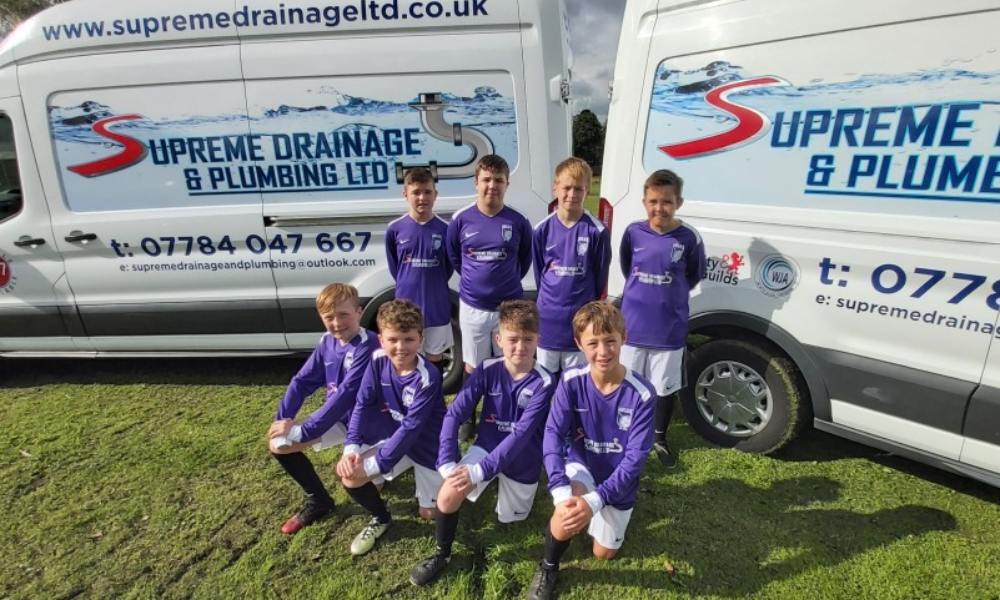
Supreme Drainage and Plumbing sponsored the Leeds 28 FC Under 13s home and training kits
Networking: still the cheapest way to start
If you're building a plumbing business from scratch, or still at the stage where time is more available than budget, networking is where to start. Local business groups, BNI chapters, chambers of commerce. These put you in rooms with estate agents, builders, letting agents, property managers, and other tradespeople who will regularly need a plumber and regularly get asked by their clients who to call.
The value of networking isn't in the direct sale. It's in the referral relationships that develop over time. A letting agent who manages 200 properties and recommends you as their trusted plumber is worth more than most marketing budgets. Those relationships are built by showing up, being helpful, and following up. Not by handing over a business card and waiting.
Referrals convert at a much higher rate than any cold lead channel, because trust is already built in. They're also free. The referral programme guide covers how to make this more systematic rather than leaving it to chance.
The role of paid advertising
Paid advertising has a place in a plumbing marketing strategy, but it works best as an accelerant on top of a solid foundation, not as a substitute for one.
Google Local Service Ads are the most cost-effective paid channel for most UK plumbers right now. You pay for leads, not clicks, and the Google Screened badge gives you a credibility signal that standard ads don't have.
Google Ads (standard pay-per-click) work well when your website is strong and you can afford to test and optimise. The cost per click for plumbing-related terms in most UK cities has climbed sharply in recent years as more businesses compete for the same searches. A landing page that converts poorly will burn through budget fast.
Facebook and Instagram advertising is more effective as a brand-building channel than as a direct lead generator for emergency plumbing. People don't open Facebook because they have a burst pipe. They search Google for that. Running targeted local ads builds familiarity so that when they do search Google and see your name, it's already familiar. Familiarity converts.
Whatever you spend on paid advertising, track it. Know your cost per lead. Know your close rate. Know your average job value. Without those numbers, you're guessing. And guessing gets expensive fast. The marketing budget guide covers how to build a budget based on the revenue you actually want to generate.
Video: the channel most plumbers ignore
Video is one of the least used and highest-impact channels available to a plumbing business. Most plumbers don't bother. That's an opportunity.
A short YouTube video walking through a common plumbing problem ("how to tell if your pressure relief valve needs replacing" or "what to do when your boiler loses pressure") does two things at once. It establishes you as someone who knows their trade. And it puts content out that sits on the internet indefinitely, being found by people who search for those terms, long after you've moved on.
Paid ads stop the second you stop paying. Video content stays. A video you made three years ago can still be bringing in enquiries today.
You don't need a production crew. A decent phone, decent lighting, and a lavalier microphone is enough to start. What matters is being clear, practical, and genuinely helpful, not polished production. When people find themselves watching your videos because they're useful, something shifts. You stop being a business and start being a trusted advisor. Those people call you when they need a plumber because they already feel like they know you.
Making it all work together
The businesses that grow most reliably don't do any single thing brilliantly. They do all of the basics consistently.
They maintain their Google Business Profile. They ask for reviews after every job. They have a van that looks professional. They stay in touch with past customers. They show up in the community. They answer the phone. And when they can't, someone covers it or it goes to a voicemail that sounds like a business they'd trust.
None of those things is expensive. Most of them are free. The discipline is the hard part. Not the knowledge.
For the operational side of things, being able to manage jobs, track where enquiries come from, and send invoices quickly from site is what separates a business that looks professional from one that doesn't. The job management platform and CRM in Fieldmotion handle those workflows so the marketing you're doing to bring people in isn't undermined by a slow callback or a scruffy paper invoice.
Related reading:
-
How to set a marketing budget for a field service business — reverse-engineering the spend you actually need
-
How fast you respond to enquiries is costing you more jobs than you think — what happens to marketing spend when response time is slow
-
The field service website checklist — making sure your digital front door isn't losing people before they contact you
-
How to build a B2B referral programme — systematising word of mouth
-
How to get more HVAC clients — the same principles applied to heating and cooling businesses
-
How to ask customers for reviews — turning satisfied customers into consistent review generators
-
Local SEO for field service businesses — Google Business Profile, citations, and local search ranking in depth


