
The Counties Where Ireland's Trade Workforce Is Ageing Fastest
-

-
-

24 Nov, 2026
-

6 min read
-
Ireland's skilled trade workforce is ageing.
The 2022 Census found around 160,000 people were working in skilled construction, building, metal, and electrical trades, with nearly 42% of them aged 45 or older, while young people aged between 15 and 24 only made up 11.6% of the total skilled trade workforce.
According to Ireland’s largest business representative group (Ibec), the construction sector overall employs 177,600 people, but needs to add 100,000 roles to meet the government’s housing and infrastructure goals.
The sector employs approximately 54,400 fewer people than at its 2007 peak, and according to Ibec’s estimate, 20% of those currently employed in construction are expected to retire in the next decade.
Nationally, for every young person aged 15 to 24 working in skilled trades, there are 3.6 people over 45. The trades workforce is getting older. In 2011, the average bricklayer or stonemason was 41. By 2022, they were 45. Plasterers went from 40 to 44 over the same time. Painters and decorators had an average age of 47 in 2022, up 3 years from 2011.
The State Pension age in Ireland is 66, but many tradespeople leave their jobs before that because the work is hard on their bodies.
Which Parts of Ireland Have the Oldest Tradespeople?
And here's the bigger question...
If the older generation is heading for retirement and young people aren't stepping in, who's going to build the country's future?
To find out, we analysed the 2022 Census. In every county, we took all the skilled tradespeople, from builders to electricians, and split them into three age groups.
-
15 to 24
-
25 to 44
-
45 and over
The Counties Most at Risk
On a national level, we found that of the 167,252 employed across the skilled trades listed above, 41.9% were 45 or older, while only 11.6% were between 15 and 24.
The remaining roughly 77,000 tradespeople fall into the 25 to 44 age group, making up 46.4%.
The 5 counties that had the highest levels of older tradespeople were all in the west and south-west, with workers aged 45 and up outnumbering the core 25 to 44 age group.
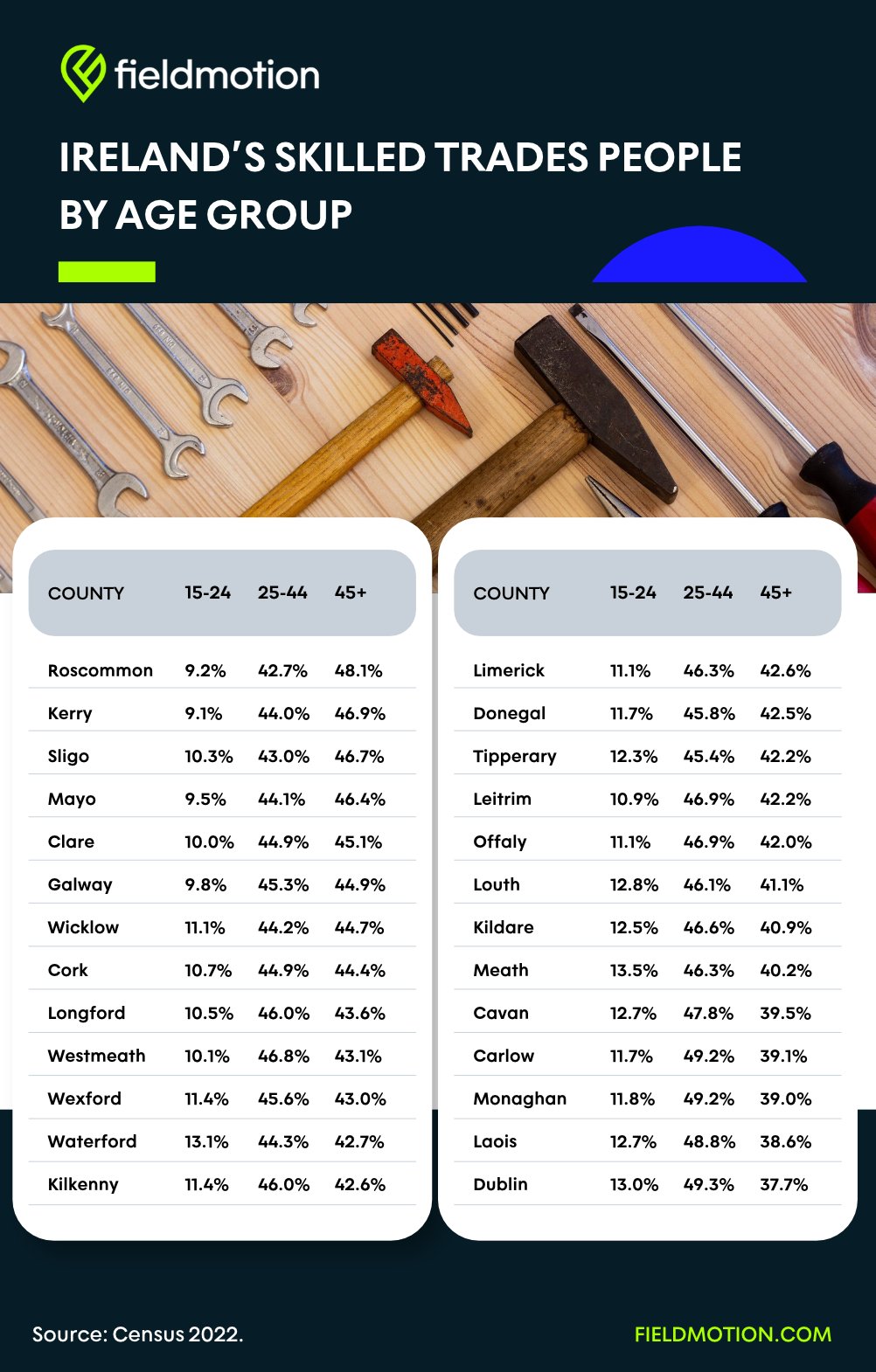
Roscommon had the highest percentage of skilled trade workers aged 45 and above at 48.1%. This is paired with one of the lowest levels of young people working in the trades at 9.2%.
Kerry ranks second. It had the 2nd highest share of trade workers above the age of 45, and the lowest share of 15- to 24-year-olds working in the trades.
Sligo has the third-highest share of older trade workers in the country. Of its 2,018 tradespeople, 943 (46.7%) are aged 45 or over. At the other end of the scale, just 208 are aged 15 to 24, the seventh-lowest number of young trade workers in Ireland.
Next is Mayo, where 46.4% of tradespeople are 45 or over. Young workers are scarce, too. Only 449 of the county's 4,732 skilled tradespeople (9.5%) are under 25, the third-lowest share in Ireland.
In Clare, older workers just edge out the middle age group. Of the county's skilled tradespeople, 45.1% are aged 45 or over, compared with 44.9% aged 25 to 44. Young people make up just 10%.
And finally, Wicklow, where older workers make up 44.7% of the workforce, compared with just 11.1% for young people.
What Does This Mean for the Skilled Trades Sector?
An older trade workforce does not necessarily mean a less productive one; the danger lies in the fact that young people are not replenishing the cohort of the workforce that is set to retire.
Older workers tend to bring more skill and experience to a job, but many leave the trades earlier than in other careers, as manual jobs take a toll on the body.
They are essential for training and developing the next generation, so if older skilled tradespeople are leaving the trades without young people learning from them before they do, the labour shortage issue will worsen.
The ‘Core’ Workforce
So which counties are in good shape? In most of Ireland, it's the 25- to 44-year-olds who do the heavy lifting, making up the largest share of skilled tradespeople. This group is strongest in Dublin, Monaghan, Carlow, Laois and Cavan. It's weakest in Roscommon, Sligo, Kerry, Mayo and Wicklow.
What's more, those top five counties seem to have found the right mix. They have the five lowest shares of older workers nationally, and a good number of young people are coming through. Meath deserves a mention too. It's not far behind the top five, with only slightly more older workers and slightly fewer in the core age group. And it beats every other county for young tradespeople, at 13.5%.
Where Are Young People Entering the Trades?
Waterford sits right in the middle of the table for older workers, ranking 12th with 42.7% of its tradespeople aged 45 or over. But it really shines when it comes to young talent. At 13.1%, it has the second-highest share of young tradespeople in Ireland. That may come as no surprise, as previous research from Fieldmotion named Waterford the best county in Ireland for a trade apprenticeship.
The counties with the youngest tradespeople include:
-
Meath: 13.5% young, 40.2% older
-
Dublin: 13% young, 37.7% older
-
Louth: 12.8% young, 41.1% older
-
Laois: 12.7% young, 38.6% older
Part of the reason could be simple. Young people go where the work is. A GeoDirectory report found that Meath, Dublin and Louth were among the top five counties for the share of homes under construction in Q2 2026.
Why Is the Skilled Trade Workforce Ageing?
Ireland needs more tradespeople than ever. The government has set ambitious housing targets, Dublin's MetroLink and data centres are going up across the country. But research shows fewer young people are entering the construction trades than in the past, meaning the pool of workers to replace those retiring is getting smaller.
And with an estimated 20% of the construction workforce set to retire in the next decade, not having a system to replenish the workforce is not sustainable. But why aren’t young people entering skilled trade professions at the same rate as they used to?
Many young people are pursuing university education rather than undertaking a skilled trade apprenticeship, while some who are qualified tradespeople emigrate to countries with better salaries or working conditions.
A 2023 study of fifth- and sixth-year students in Ireland found that 75% were encouraged to go on to higher education after school. Just 6% were encouraged towards a skilled trade or apprenticeship. The study also found that only 11% of students were considering a trade or apprenticeship after school. However, 47% said they would think about an apprenticeship if they didn't get into their chosen college course.
Methodology
We analysed Census data from 2022 to count the number of skilled tradespeople in each county, covering construction and building trades as well as metal, electrical and electronic trades. We split these workers into three age groups and worked out what percentage of each county's trade workforce fell into each one.


